
Got a rough boundary marked out and a metre figure written down? Good start. The next question is usually simple: how many barricade poles do I need?
If the site needs 60 metres of barricading, it is tempting to divide 60 by the pole length and call it done. That gives you a starting number, but not the final answer. Hard barricading rarely sits in one neat, uninterrupted line. It turns corners, wraps around work areas, branches into separate zones and still needs a sensible way for authorised people to get in.
The distance gives you a starting point. The shape determines how many poles and supporting components the system actually needs.
Start with the shape, not the metre count
Picture two sites that both require 60 metres of hard barricading. One needs a single straight boundary beside a trench. The other needs to wrap around equipment, turn two corners and include a gate. The total distance may be similar, but the component lists will not be.
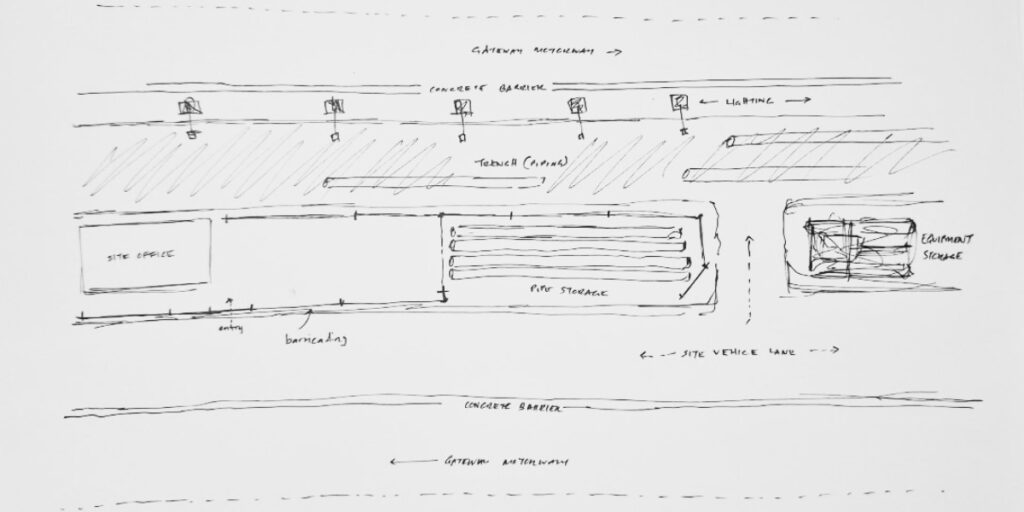
Before counting anything, sketch the proposed barricade line. Mark each straight run, every corner or branch, nearby pedestrian and vehicle routes, existing structures and the point where authorised personnel need to enter.
It does not need to be a polished site plan. A marked-up screenshot, photo or rough pencil sketch with measurements is enough to show what the barricading actually needs to do.
The final position and setback must still reflect the site’s risk assessment, procedures and the hazard being controlled. Once that boundary is established, the system can be built around it.
Break the layout into actual runs
Do not treat the whole perimeter as one long number. Measure each straight section separately, then note what happens at the end of it.
Does it stop? Turn a corner? Meet another barricade line? Branch into a second zone? Each change affects the poles and legs required.
This is where a simple metre count usually falls apart. A straight run is straightforward. Corners need swivel connections. T-sections and other branches need another configuration. A complete enclosure also needs a planned access point.
Should I use 2.9 metre or 5.8 metre poles?
Eureka Heavy Duty Barricade Poles are available in 2.9 metre and 5.8 metre lengths. You do not need to force the entire site into one option.
For long, open boundaries, the 5.8 metre poles cover more ground with fewer individual spans. The 2.9 metre poles give you more control around confined spaces, short returns and irregular work areas.
On many sites, the most practical answer is both. Use longer poles where the layout allows it and shorter poles where the barricading needs to tighten up.
How to estimate the number of barricade poles
Start by measuring each straight barricade run separately. Divide the length of each run by the pole length you plan to use, then round up to the next complete pole.
60 metres / 5.8 metres = 10.34 poles
Rounded up, that is 11 barricade poles as a starting estimate.
It is only a starting estimate, not the final quantity.
Eureka’s poles overlap through the supporting legs, so a 5.8 metre pole does not create a finished 5.8 metre span. Corners, branches, end points and gate placement can also change the quantity required.
Work through every run separately, then check how those runs connect. That final connection check is what turns a rough pole calculation into a usable barricading layout.
The poles are only half the system
The 2-Way Fixed Twin Rail Barricade Leg is designed for continuous straight runs, supporting the overlapping poles through each connection point.
The moment the barricading needs to turn or branch, the 4-Way Swivel Barricade Leg comes into play. It allows poles to continue at different angles and can form corners, T-sections, Y-sections and four-way intersections.
That is why the leg quantity does not simply match the pole quantity. The layout decides how many fixed and swivel legs the system needs.
Where are people getting in?
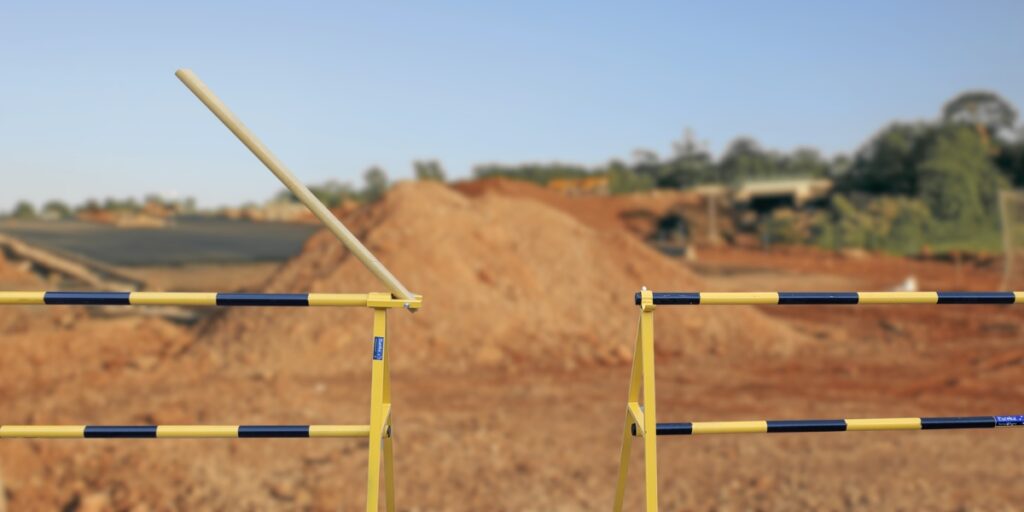
If the barricading forms an enclosure, authorised personnel still need a proper entry point. Include the barricading gate in the layout from the beginning instead of trying to create an opening later.
Think about where people approach from, what needs to pass through and whether the gate could interfere with a vehicle route or another work area. The best gate location is not always the shortest walk. It is the one that keeps entry controlled without making the surrounding barricade a nuisance to use.
Will it stay that shape?
Probably not.
A straight boundary may become an enclosure. A work area may expand, move or divide into two zones. What suits the first stage of a shutdown may not suit the final stage.
Think one step ahead while the system is being quoted. A useful mix of pole lengths, fixed legs and swivel legs gives the site room to reconfigure the barricading without starting again.
What about a larger system?
Once the quantity starts growing, storage and movement become part of the setup. A system is not especially useful if half the components are loose, difficult to move or scattered across the yard.
Eureka offers purpose-built pole and leg stillages, along with a Mobile Barricade Storage and Deployment Trailer, to keep larger hard barricading systems organised and ready to deploy.
What to include with your quote request
A rough sketch is often more useful than a total metre figure. The following information will help the Eureka team understand the job and work through a practical component mix.
| Information | What to provide |
| Layout | A sketch, marked-up site plan or photo showing the proposed barricade line |
| Measurements | The length of each straight run rather than only the total perimeter |
| Connections | The number of corners, branches, intersections and end points |
| Access | The location and number of required entry gates |
| Site Conditions | Nearby pedestrians, vehicles, plant, structures and changes in ground level |
| Work Stages | Any likely extensions, relocations or layout changes |
| Delivery | The project location and required timeframe |
Send us the sketch
Even a scrappy pencil line or screenshot with measurements gives us something useful to work with. We would rather see the shape of the job than guess from one total metre figure.
Important: The selected barricading must reflect the site’s risk assessment, procedures and the specific hazard being controlled. General hard barricading should not automatically be treated as certified edge protection, fall protection or vehicle-impact protection.
Send Eureka a sketch or approximate site dimensions and our team can help identify a practical combination of barricade poles, fixed legs, swivel legs, gates and storage. Explore the full Eureka Hard Barricading System or contact us on 1800 897 989 for pricing, availability and project advice.